
Astra extra high vs SWE-2: lighthouses and racing cars
GPT-6 Astra at extra-high reasoning and Devin SWE-2 High run the same eleven tasks, including a rotating voxel lighthouse and a car racing game.
I added two visual tasks to the benchmark: a detailed voxel lighthouse with an orbit camera, and a playable car racer. This run compares GPT-6 Astra at extra-high reasoning with SWE-2 High through the Devin CLI, across all eleven tasks.
The extra-high setting is explicit. The Codex wrapper passes model_reasoning_effort="xhigh" alongside gpt-6-astra. Devin gets the exact swe-2-high model identifier from its authenticated catalog. Neither relies on whichever model happened to be selected in the terminal last.
Results
Scores are out of 100. Each cell shows the mean (minimum to maximum) across successful attempts. I requested three fresh attempts per task. Astra delivered 33/33 artifacts; SWE-2 delivered 32/33, with its third lighthouse attempt hitting the 25-minute limit. Delivery does not mean every behavioural check passed.
| Task | Astra extra high | SWE-2 High |
|---|---|---|
| N-Body Field | 97.0 (97 to 97) | 100.0 (100 to 100) |
| Mini Platformer | 99.0 (97 to 100) | 100.0 (100 to 100) |
| Crypto Hash Race | 98.7 (96 to 100) | 98.7 (96 to 100) |
| Landing Page Morph | 62.0 (62 to 62) | 100.0 (100 to 100) |
| Equation Solver | 100.0 (100 to 100) | 76.7 (30 to 100) † |
| Physics Pendulum Wave | 100.0 (100 to 100) | 100.0 (100 to 100) |
| Circuit Builder Teaser | 100.0 (100 to 100) | 100.0 (100 to 100) |
| Tic-Tac-Toe | 100.0 (100 to 100) | 66.0 (30 to 100) |
| Gateway Console | 100.0 (100 to 100) | 100.0 (100 to 100) |
| Voxel Lighthouse | 97.0 (97 to 97) | 98.5 (97 to 100) · 2/3 completed |
| Car Racer | 97.0 (97 to 97) | 97.0 (97 to 97) |
Every other cell has three completed attempts. The lighthouse timeout remains in SWE-2’s trace and completion count; it is not included as a zero in the score mean. These are task-specific rubric scores, not a general coding ranking.
† One SWE-2 equation answer lists the correct four solution pairs, but its graphing script uses the browser DOM. The existing executable scorer tries that script in Node and awards 30; prose-only answers use a structural fallback. That low score is not evidence of an algebra error. This mismatch, and the landing-page animation check described below, make an overall league-table verdict unhelpful.
The new tasks are consistent on the tested interactions: all completed lighthouses and racers pass their behavioural checks. Their remaining point differences come from structural HTML heuristics. SWE-2’s Tic-Tac-Toe results are less consistent: one attempt fails to alternate turns, and another misses a winning line. Its third platformer also logs a ty is not defined error despite earning full points on the narrow movement checks. The trace is part of the result, not just the headline number.
A lighthouse you can look behind
The lighthouse task asks for actual 3D geometry in a Minecraft / Roblox inspired style. Its brief includes a striped tower, lantern room, balcony, keeper’s cottage, rocky island, dock, boat, foliage, waves, birds and clouds. Automatic rotation reveals each side. Pointer dragging lets the reader inspect a particular view.
The automated checks cover rotation and pause, manual orbit from a frozen scene, and a camera reset that returns to the same view. They cannot tell us whether the lighthouse looks good, or whether the author used genuine 3D geometry. Those questions need the rendered artifact and source.
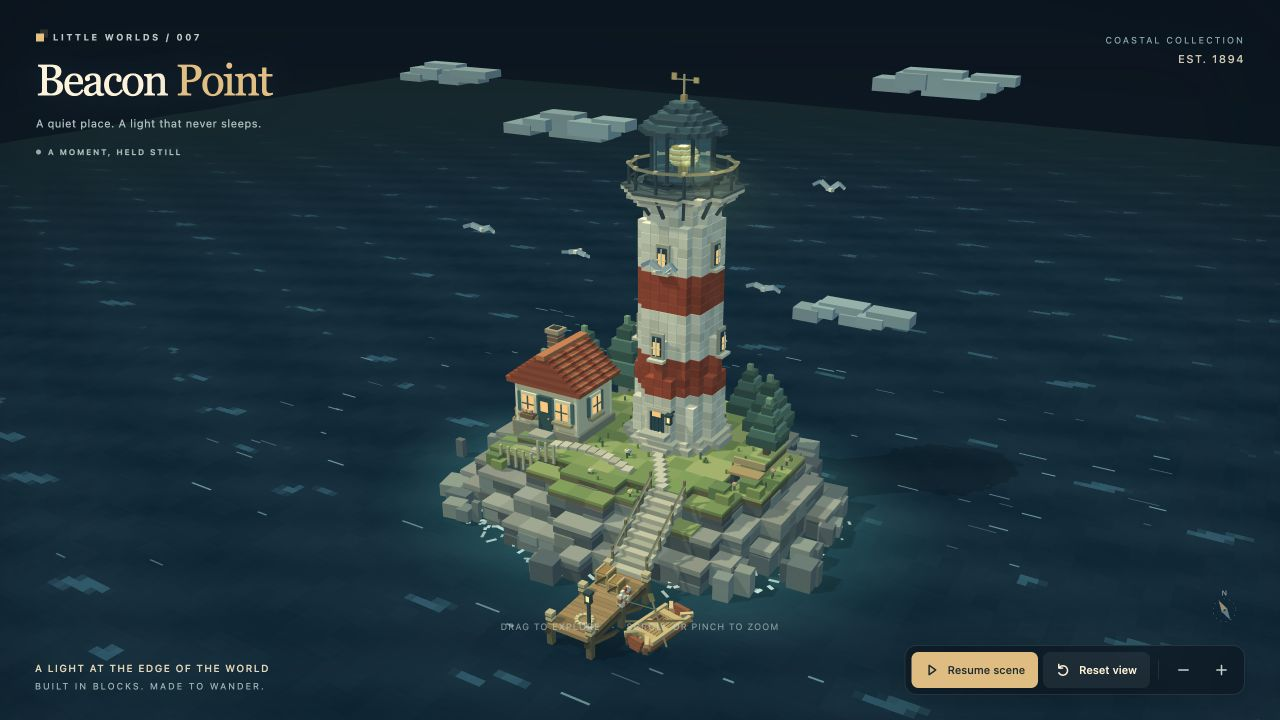
The first Astra attempt, pictured at the top of this post, uses WebGL geometry, depth testing and a shadow map. Its island has a stepped stone shore, stairs to the dock, a rowboat, a lit cottage, pine trees and balcony rails. The lighthouse remains easy to read against the darker sea.
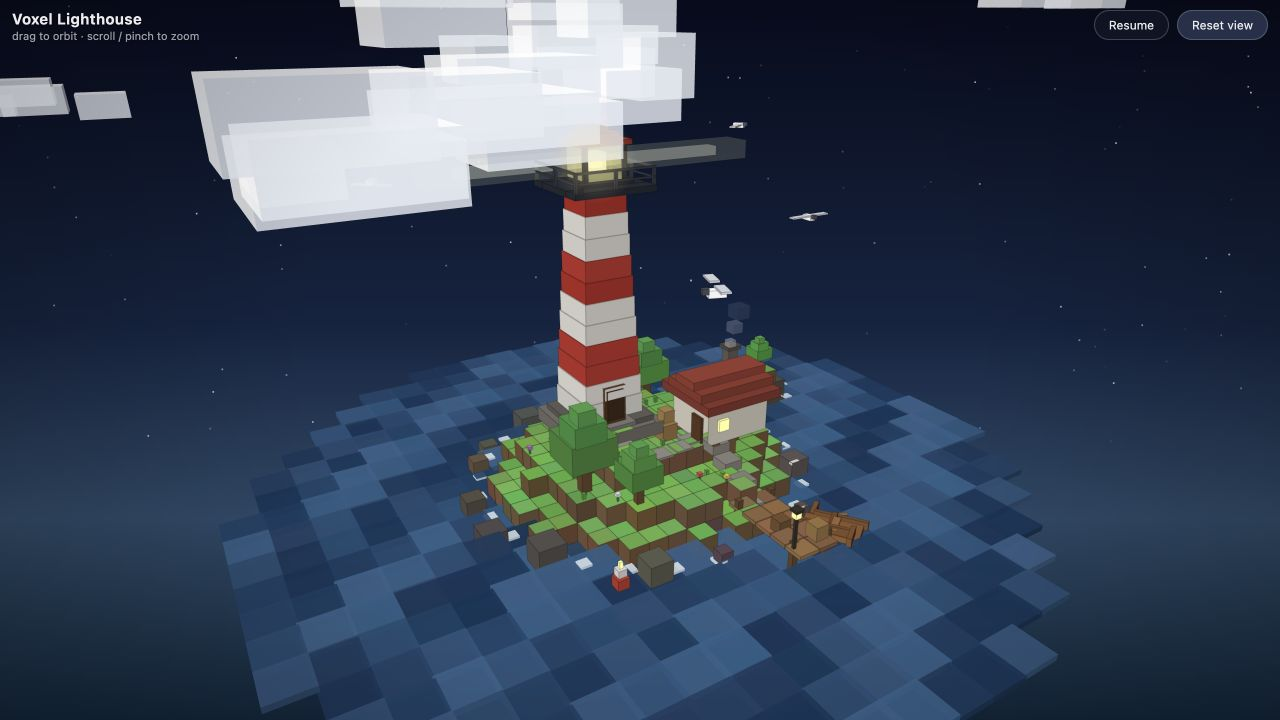
SWE-2's first attempt uses its own projected 3D renderer on a 2D canvas: the source transforms cuboid vertices, applies perspective and sorts faces by depth. It includes the cottage, dock, boat, foliage and birds. Its large foreground clouds obscure the lantern in the reset view. That composition problem is visible here but earns no penalty from the interaction checks.
The screenshots in this post show each agent's first attempt, without source edits. The interactive task pages select the highest-scoring successful attempt instead.
A racer that responds to the controls
The car racer task asks for acceleration, braking, steering, rival cars, collisions, off-road slowdown and laps with ordered checkpoints. It also asks for keyboard and touch controls.
The scorer drives the car with real keyboard events. Acceleration and steering must change the canvas and the vehicle telemetry requested in the prompt. Braking must reduce speed. Restart must clear speed and distance and restore heading.
That is a useful subset, but it is still a subset. Rival AI, collision realism, checkpoint ordering and touch controls are outside the automated checks. The telemetry also comes from the artifact itself. A passing score is evidence about the tested interactions, not proof that every part of the game works.
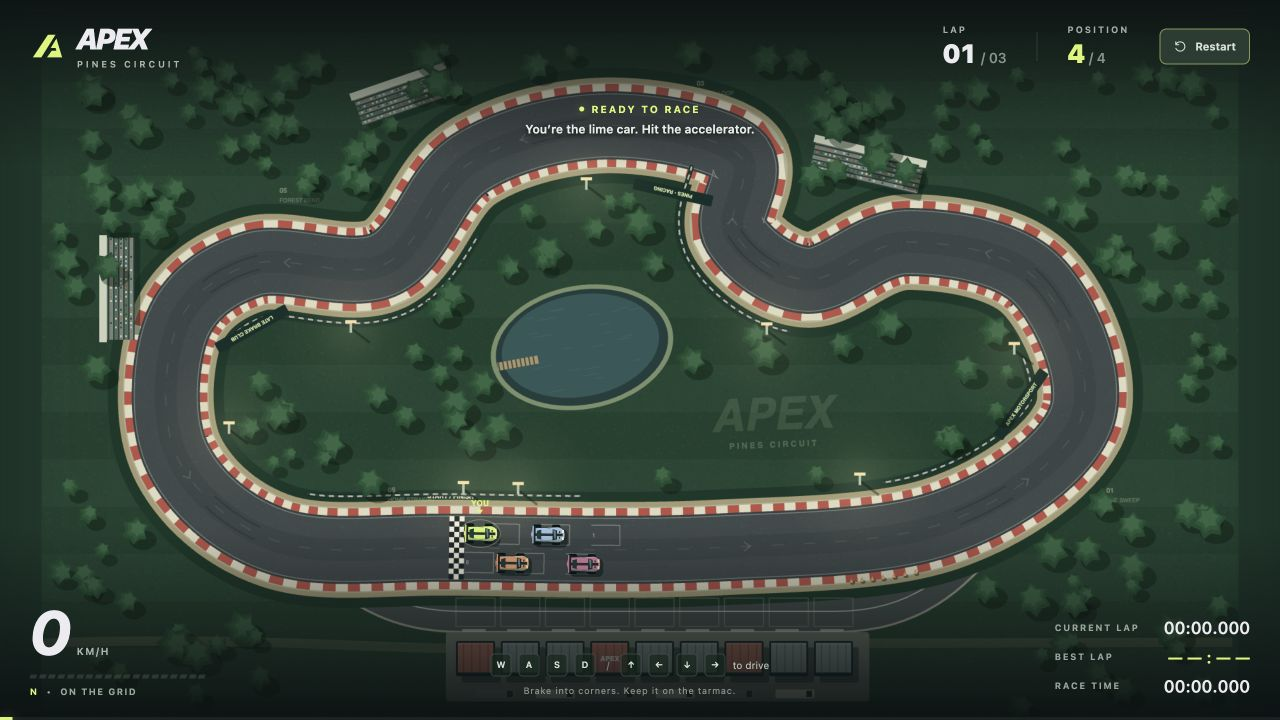
Astra's first racer keeps the whole circuit on screen. Its scenery includes grandstands, lamp posts, a pond and forest, with the player identified as the lime car. The source includes off-road slowdown, rival movement, collisions and ordered checkpoint logic. Those features need longer playtesting than this benchmark provides.
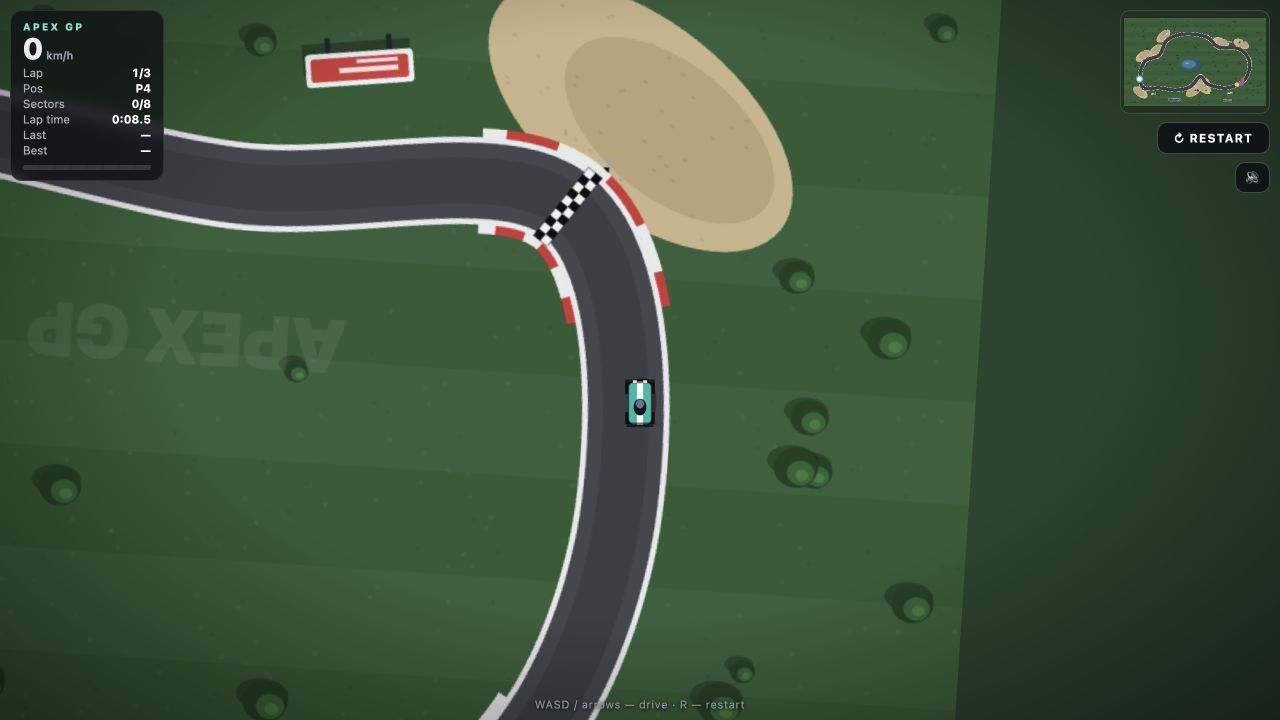
SWE-2 chooses a close following camera and a minimap. Its compact HUD makes the player car easier to pick out, while the full circuit is less visible. Both are recognisable racing games. The scores concern their tested behaviour, not a visual preference between these camera choices.
The check guardrail is checks.test.ts: working fixtures pass, static fixtures fail, and missing controls keep their point budgets. An omitted button therefore cannot improve the score by shrinking its denominator.
Methodology and reproduction
Both agents receive the same task prompts and offline execution contracts. The astra-devin profile uses three fresh attempts per task and four concurrent task/model jobs per sweep. Each generation has a 25-minute cap and zero transient retries. The shared runner retains its existing recovery for empty replies. Browser tasks use Chromium, with the harness’s existing 70% behavioural / 30% structural weighting. The browser runs with the recorded partial sandbox policy and prelude parity off. The corrected Devin sweep overlapped the first sweep on the same machine. Runtime records those conditions rather than an isolated speed comparison.
These are agent-system results. Codex and Devin bring different tools, system prompts and local rules, so the comparison does not isolate the underlying model. Both use a fresh scratch workspace under the repository's sweep directory. Three attempts can expose inconsistency but cannot establish a broad ranking of coding ability. Older rows used different prompts, scorers or sample counts. This table compares only the matched September runs.
Some older task rubrics are narrow. Landing Page Morph looks for spontaneous canvas or text changes. It does not operate the theme toggle or recognise a CSS-only transition. Equation Solver can fall back to structural scoring for a prose answer. Crypto Hash Race executes functional comparison checks but does not prove constant-time behavior. Those limits are visible in the task notes and matter when interpreting a high or low score.
The published demo is each task's highest-scoring successful attempt. Its score in the table remains the mean across successful attempts. The iteration trace exposes the other attempts, including failures.
The first Devin sweep exposed a wrapper error: Accept Edits mode allowed file creation but stopped at command approval. Its commentary could then pass through the old stdout fallback. I excluded that sweep from the comparison and cancelled its remaining lighthouse and racer attempts. Those cancellations are diagnostics, not model failures in this table. The corrected wrapper uses sandboxed Autonomous mode and asks for artifact creation through exec. Devin's direct file tools still prompt in that mode. A new preflight verifies both a command-created file and the final HTML. A missing artifact now fails instead of receiving a score for commentary.
Artifact review also found harness errors. Python import shims interfered with standard-library imports and split test blocks. HTML cleanup could discard the start of an already complete document. Canvas capture could read a cleared WebGL drawing buffer while the screen visibly animated. Each correction has a regression fixture.
Another staged pass failed every racer check because the CLI's TypeScript loader inserted a helper unavailable inside the browser. Vitest's different transform had hidden the bug. A new test runs the working fixture through the actual CLI loader and catches it. That staged pass is excluded too.
The final grading pass scores both sets of retained artifacts after generation finishes, one artifact at a time. It allows five seconds per screenshot and new-task control action, 20 seconds per check and 90 seconds per browser batch. Earlier screenshot and click deadlines were too short for the rendered WebGL scenes. A browser-launch race that leaked extra browser processes is also fixed. Both agents receive the same normalization and scoring, without manual source repairs or new model calls. Vendor dependencies must match bytes embedded in the original trace.
The new traces identify their source run and scorer commit. They retain original generation timestamps, runtimes and token estimates. Public traces redact credential-like strings, so a Python example in the trace may differ from the retained file used for execution.
CLI token counts are estimates. Astra ran through a Codex subscription. The Devin catalog listed SWE-2 High as free on the run date. Zero recorded API cost is not a subscription-cost or billing measurement. See the Devin CLI documentation for the product route used here.
Astra began at commit 5be874d4ba5ceb3abbfe3d75f7be0e2ba5b7f5de, with Codex 0.153.4, in sweep 2026-09-22T08-50-23. The accepted Devin sweep is 2026-09-22T09-53-42, using Devin 3000.11.1 and harness commit 2c3919956d10994da99a2d36928005b1713d58b1. Task prompts are unchanged. The harness corrections above apply to both published sets. Final grading uses commit 01ea98c5c678a2cb438739d8344933afb1fde355 and sweep 2026-09-22T11-23-58-astra-devin-final. It retains the 65 delivered artifacts and the one generation timeout. Task pages expose the generated output and iteration trace.
npm ci
npx playwright install chromium
task bench:devin-preflight
npx tsx scripts/run-benchmark.mjs --profile astra-devin \
  --model codex-gpt-6-astra-xhigh,devin-swe-2-high --dump-config
npx tsx scripts/run-benchmark.mjs --profile astra-devin \
  --model codex-gpt-6-astra-xhigh,devin-swe-2-high
The source prompts, model settings and per-check results matter more than a single average. They let us come back to a failure, reproduce it, and decide whether it belongs to the artifact or the scorer.
Try it in the lab
All effects →A* Pathfinder
aiA*, Dijkstra, and greedy best-first search — the heuristic pulling the frontier toward the goal.
searchgraphsa-starGradient Descent
aiSGD, Momentum, RMSProp, and Adam racing down a loss landscape — ravines, saddles, and local minima.
optimizationdeep-learningtrainingk-Means Clustering
aiLloyd's algorithm on Gaussian blobs — points snap to their nearest centroid, then centroids glide to each mean.
clusteringunsupervisedlloyd
More from the blog
The behavioural scorer caught a model lying about its own game
We wired three frontier-class models (Gemini 3.6 Flash, Claude Opus 4.6 thinking, and GPT-OSS 120B) into the same 7-task harness via the Agy CLI, then switched the scorer from HTML structure to Playwright behavioural checks. The headline result: a model that scored a perfect 100 on the platformer task under the old scorer scored 30 under the new one, five iterations in a row, because the Space key never actually jumped.
Twelve free models just walked into our benchmark — three of them beat the frontier
We wired OpenRouter's free tier into our 7-task LLM harness, registered 13 models with full metadata, and ran a fair 5-iteration sweep across all of them. Ling 3.0 Tiny, Laguna XS 2.1 and Gemma 4 26B posted averages above 98 on a board that Kimi K3 leads at 90.5 — and the entire run cost us nothing.
We pointed our own benchmark at Kimi K3 on launch week
Our 7-task harness renders (or shows) what models actually generate, live and sandboxed. Running Kimi K3 against K2.7, Gemini and Codex broke the harness three different ways before it produced a fair table — here's the data, and what K3 is actually good at.